Musical-Mente

A proof-of-concept Spanish language learning app that teaches culture and regionalisms using the authentic medium of music.

Three black buttons labeled 'Mobile Learning,' 'UX Design,' and 'Learner Analysis' on a dark background.
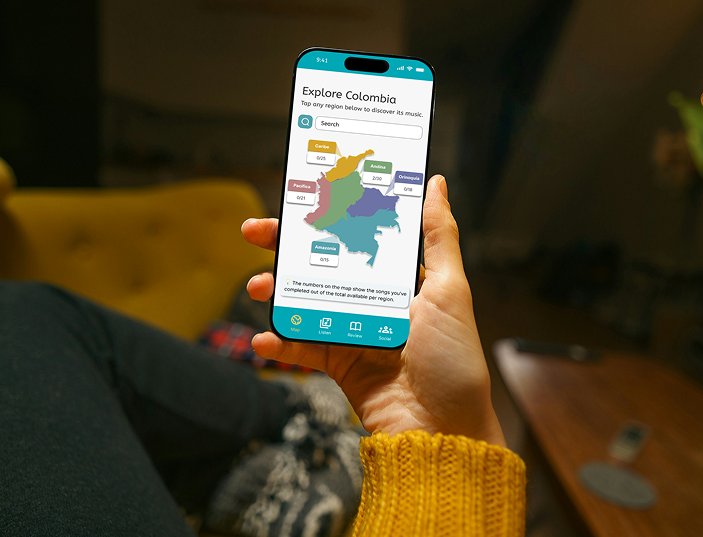
A person holding a smartphone displaying a map of Colombia with region names and numbers, in a cozy indoor setting.
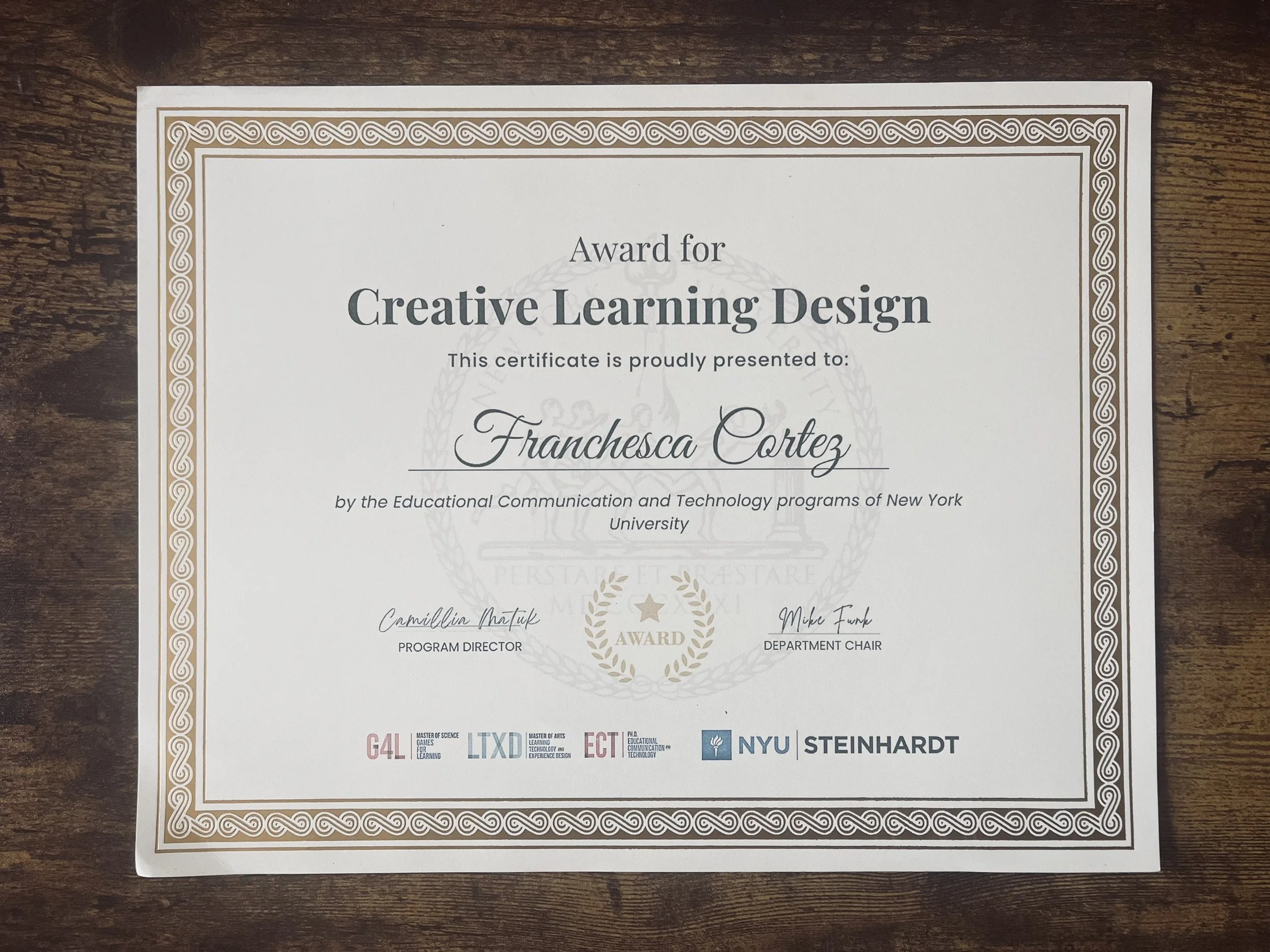
Certificate of award for Creative Learning Design presented to Franchesca Cortez from New York University.

NYU Faculty Award Recipient

This project was awarded for its excellence in bridging the gap between learning science and creative media by providing a novel solution to a real-world problem.

My Role

  • Learning & Instructional Designer

  • UX Researcher & Designer

Timeline

7 months

Tools

Figma, Google Drive, iMovie

ADDIE Model

I followed the ADDIE model in the research, design, and development of this learning app.
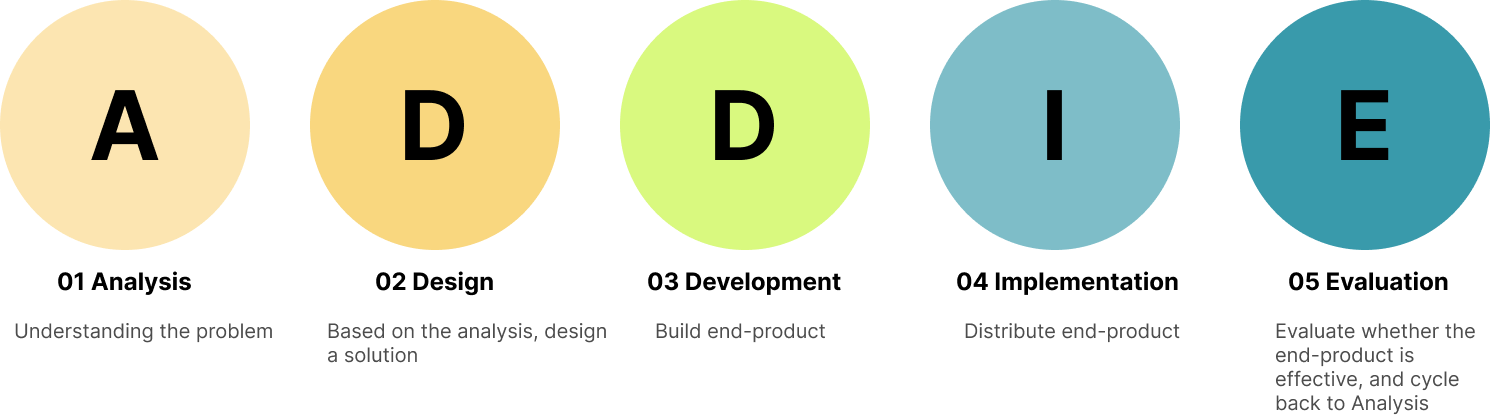
Flowchart with five colorful circles labeled A D D I E, each representing a stage in a process. The stages are: A - Understanding the problem, D - Based on the analysis, design a solution, D - Build end-product, I - Distribute end-product, E - Evaluate whether the end-product is effective, and cycle back to analysis.
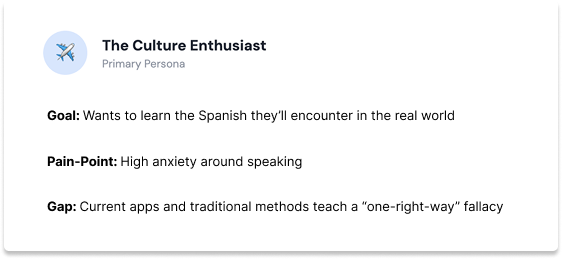
A digital illustration of a profile card for 'The Culture Enthusiast', with icons and text detailing goals, pain points, and gaps related to learning Spanish.

01

Analysis: The Problem Space

Many adult Spanish learners have a solid grasp of grammar from school, but they hit a wall. They're stuck at an intermediate level, and their progress stalls. At this stage, they often abandon learning altogether.

Key Insight: 28% of adults learn languages specifically for cultural learning and travel, yet most apps focus on rote standardized grammar and vocab.


Secondary Research Highlights
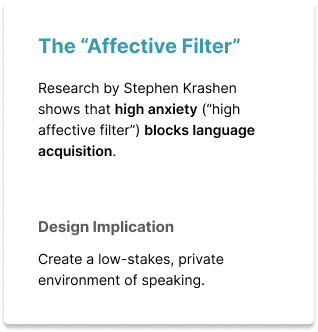
Slide explaining the 'Affective Filter,' a research concept by Stephen Krashen, stating that high anxiety blocks language acquisition, and suggesting creating a low-stakes, private speaking environment.
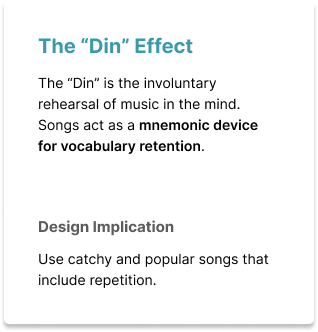
Text explaining the 'Din' effect, a mnemonic device for vocabulary retention through rehearsal and repetition with catchy songs.
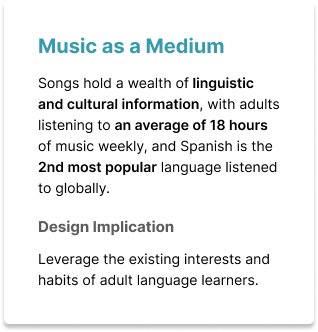
Text from a presentation slide titled 'Music as a Medium' discussing how songs convey linguistic and cultural information, average listening time of 18 hours weekly, and the importance of leveraging interests for adult language learners.

02

Design: Applying Learning Theory

I grounded the curriculum and the learning design in three core learning theories to ensure retention and motivation.

  • Give learners autonomy to choose a Spanish-speaking region and song of interest, which lowers the “affective filter” (anxiety) and boosts intrinsic motivation.

  • Combining auditory input (lyrics) with visual content (music videos/images/maps) creates two cognitive pathways for stronger memory retention.

  • Learners build on their existing knowledge of music and basic Spanish content to construct new linguistic understanding, rather than just memorizing rules and disconnected vocabulary.


Logic Model

The following logic model showcases a high-level view of the inputs this app requires of the learner, the outputs, and the outcomes it will achieve, while also keeping in mind the language learning pain points and context:
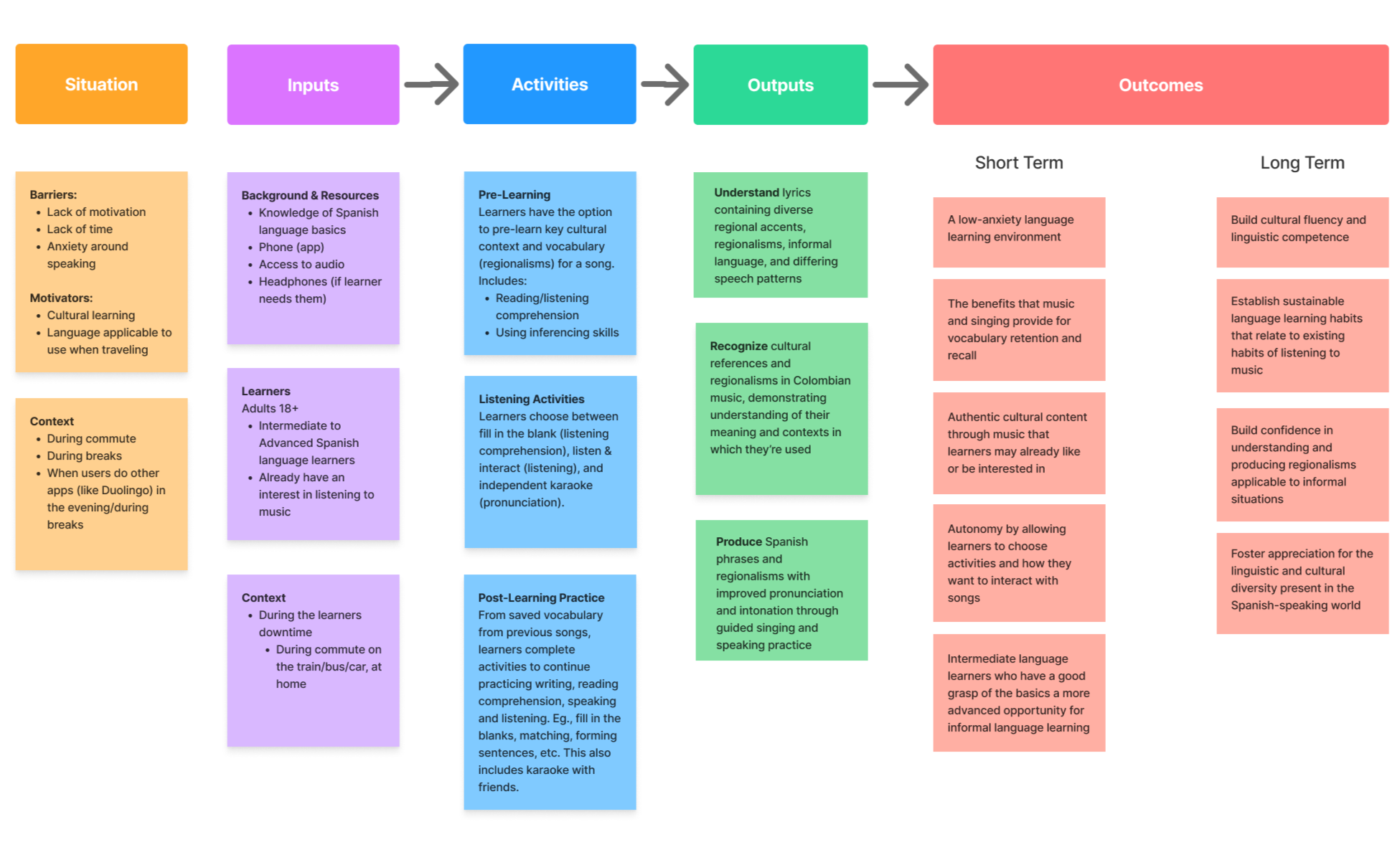
Educational chart displaying a workflow with categories: Situation, Inputs, Activities, Outputs, Outcomes, each with associated details and color-coded sections.

Learner Journey

Learners select the country, region, and song they’d like to interact with and learn

1. Option to pre-learn components of the song or go straight into interactive listening activities where they’ll see vocab in context

2. Complete post-song interactive activities with saved vocab

3. Option to invite and participate in group karaoke with fellow Spanish learning friends either in-person or remote
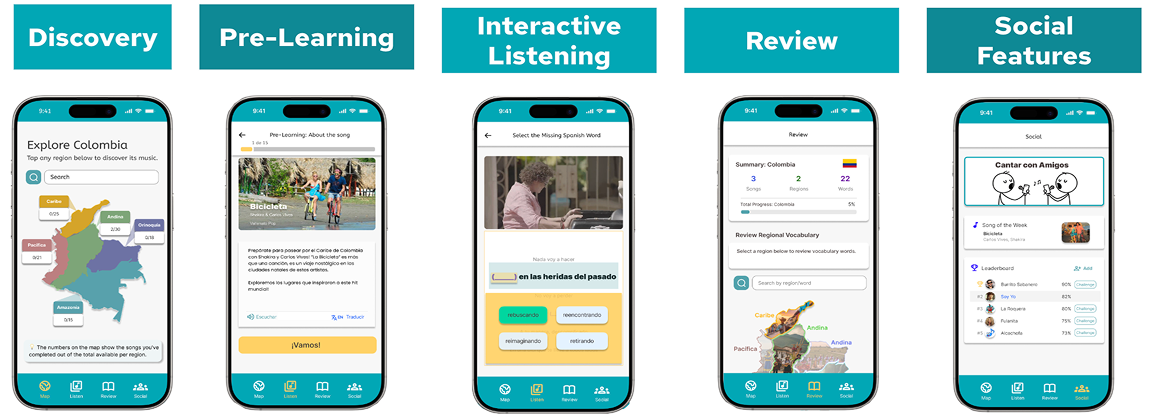

Screenshots of a language learning app with five sections: Discovery, Pre-Learning, Interactive Listening, Review, and Social Features, showing various features and activities for exploring Colombia and learning Spanish.

03

Development

I prototype the following learning design as a proof-of-concept for the Musical-Mente app. The prototype shows the full learning flow for the song “La Bicicleta” by Shakira and Carlos Vives.

Image of a label indicating 'High-Fi' prototype
Figma logo with the words 'Design Platform' underneath

04

Implementation: Pilot Testing

I validated the design using a “Think-Aloud” protocol to capture real-time reactions and mental models, and validating effective learning.
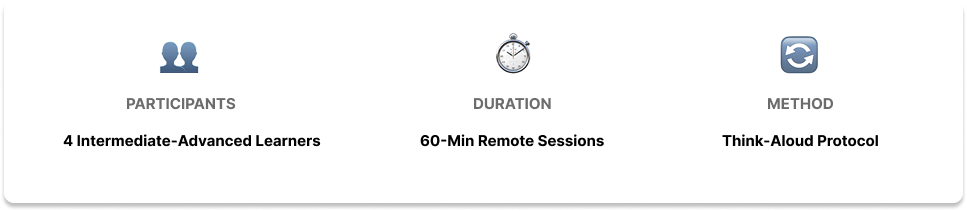
Overview of a remote learning session with 4 intermediate-advanced learners, a duration of 60 minutes, using a Think-Aloud Protocol method.
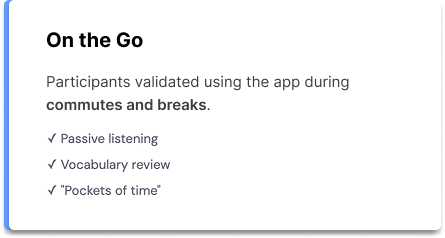
Slide titled 'On the Go' listing activities validated during commutes and breaks, including passive listening, vocabulary review, and 'pockets of time'.
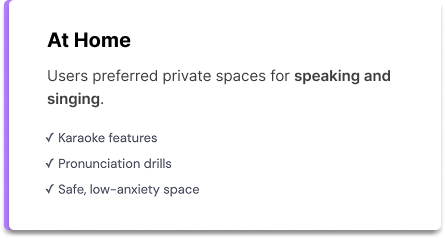
A presentation slide titled 'At Home' describing private spaces for speaking and singing, listing features like karaoke, pronunciation drills, and a safe, low-anxiety environment.

“I can see myself using this app on the subway. It fits right into my commute.” - Participant

05

Evaluation: Balancing Autonomy

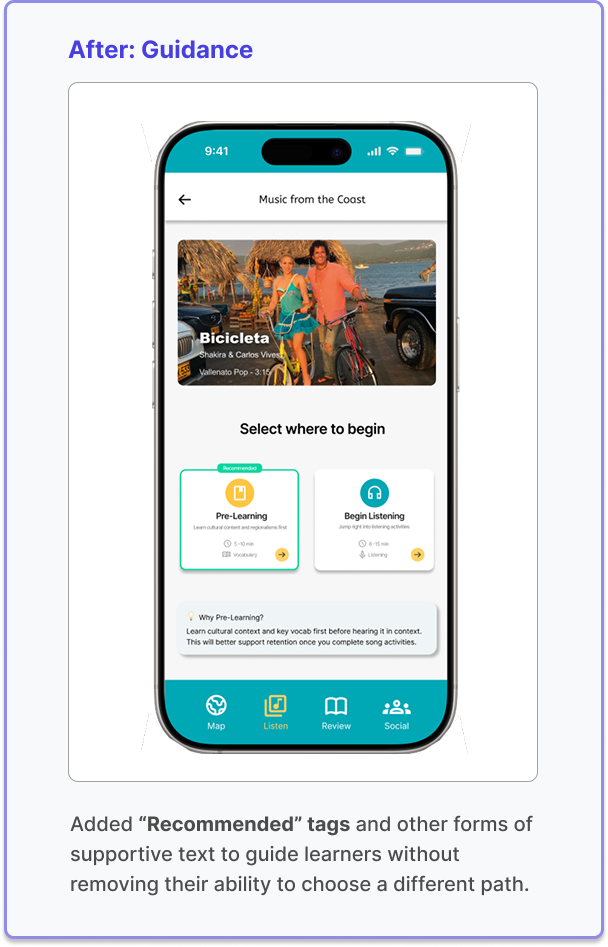
While learners wanted the freedom to choose their own path (Self-Determination Theory), testing with target learners revealed that too much choice led to confusion.

The Insight: Adult learners value autonomy, but they also need optional guidance to feel confident.
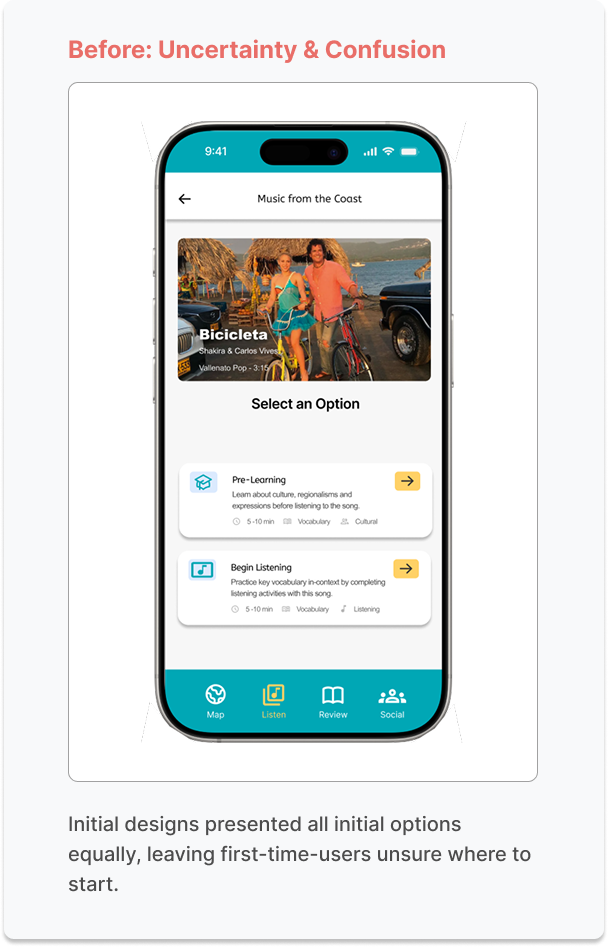
Smartphone screen displaying a language learning app with options for 'Pre-Learning' and 'Begin Listening.' The app has a navigation bar at the bottom with icons labeled Map, Listen, Review, and Social. The background includes a photo of two people walking near the coast with palm trees and a thatched roof structure.
Smartphone screen displaying a language learning app with a beach scene at the top, showing two people with bikes, and options labeled 'Pre-Learning' and 'Begin Listening' for music titled 'Bicicleta' by Shakira & Carlos Vives.
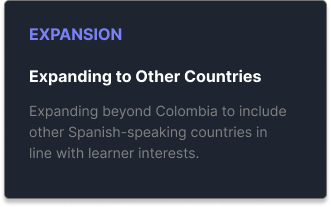
Slide titled 'EXPANSION' with the subtitle 'Expanding to Other Countries' and additional text about including other Spanish-speaking countries beyond Colombia.

Future Roadmap

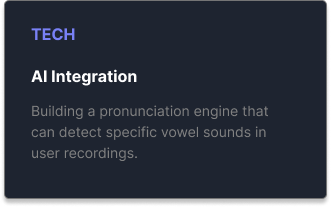
TECH section highlighting AI Integration about building a pronunciation engine for detecting vowel sounds in user recordings.
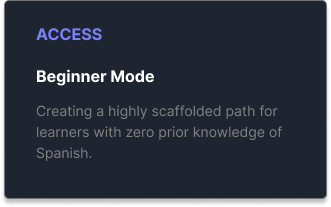
Screenshot of a digital interface menu with 'ACCESS' and 'Beginner Mode' for creating an easy Spanish learning path.